 Deutsch
 English
 Italiano
 Español
Legal inspection requirements for IBC containers: What the ADR stipulates
The ADR regulations apply to IBCs used for the transport of dangerous goods on public roads. For storage only or internal use within a facility, other regulations (e.g. occupational health and safety or industrial safety legislation) may apply.
IBCs used for the transport of dangerous goods are subject to regular inspections under ADR -- both stainless steel IBCs and plastic IBCs:
- Every 2.5 years: Recurring inspection (visual and functional check)
- Every 5 years: Recurring test by a recognised inspection body in accordance with BAM-GGR-002
- Additionally: Inspection after repairs or in the event of visible damage
Once these deadlines have expired, an IBC may no longer be used for the transport of dangerous goods until the corresponding inspection has been successfully completed. However, the transport of an empty, uncleaned IBC to the prescribed inspection or test is permitted, provided that the ADR requirements are observed (ADR 4.1.2.2). Violations of the inspection obligation can result in fines and may jeopardise insurance coverage.
What documentation do you need for an IBC inspection?
Re-approval of used IBCs is possible provided the design type is clearly identifiable and a valid UN marking is present.
Previous inspection reports or technical documentation are not a mandatory prerequisite for a new inspection. The decisive factor is that the vessel is identifiable -- via the type plate with UN approval number, manufacturer and year of manufacture. In addition, the IBC must be technically inspectable.
Also important is the type approval drawing. It shows how the IBC was originally designed and serves as a reference during the inspection. If it is not available, it can be requested from the manufacturer or the recognised inspection body.
IBC inspection procedure: From visual inspection to the new inspection mark
The ADR defines the inspection requirements and deadlines, but not a fixed inspection catalogue. The actual procedures follow recognised technical rules such as BAM-GGR-002.
A complete IBC inspection typically comprises the following steps:
- Visual inspection -- Checking for deformations, cracks, corrosion or other external damage to the vessel and cage pallet
- Wall thickness measurement -- Particularly for metal IBCs, ultrasonic testing is used to determine whether material loss due to corrosion or abrasion has occurred
- Leak test -- The vessel is tested under slight overpressure to rule out leaks
- Fitting inspection -- Valves, lids and discharge taps are checked for proper function
- Gasket replacement -- Gaskets are frequently replaced as a precaution to prevent future leaks
- Functional test -- The operability of all components is verified, including closures and drain valves
If the IBC passes the inspection, it receives a new inspection mark on the type plate along with a current inspection report. The vessel is then approved for the next inspection period and may once again be used for the transport of dangerous goods.
How long may a used IBC vessel be operated?
The maximum service life of an IBC depends on the material, the level of stress and regular inspection -- there is no blanket age limit for all types.
For composite IBCs with plastic inner containers, use for the transport of dangerous goods is limited to five years from the date of manufacture of the inner container. Recurring inspections do not extend this maximum service period. Once this period has expired, the inner container may no longer be used for the transport of dangerous goods. However, the cage pallet can continue to be used if it is intact and a new inner container is fitted (known as reconditioning).
For stainless steel IBCs, there is no fixed age limit. As long as the vessel passes the prescribed inspections within the deadlines and shows no safety-relevant defects, it may be used indefinitely. Regular inspections and proper maintenance are therefore the key to a long service life.
Important notice on deadline exceedance
If an inspection deadline is exceeded, the operating permit for the transport of dangerous goods expires. A successful inspection with the corresponding marking is required before the IBC may be used again.
An IBC with an expired inspection deadline may no longer be filled or used for the transport of dangerous goods. However, the vessel can be submitted for re-inspection at any time and, upon passing, be re-approved. The transport of the empty IBC to the inspection facility is permitted in compliance with ADR requirements (ADR 4.1.2.2).
Re-approval instead of new purchase: Costs, availability and carbon footprint
Re-approval of used IBCs is in many cases economically worthwhile -- provided the vessel is identifiable and technically inspectable.
The re-inspection and approval of a used IBC costs only a fraction of a comparable new unit. In addition to the cost advantages, further factors speak in favour of re-approval:
- Fast availability: Used IBCs are often available at short notice, while new units may have longer delivery times
- Sustainability: Every reused IBC saves resources and CO₂ emissions -- an important contribution to a company's environmental footprint
- Equivalent safety: An inspected and approved used IBC meets the same safety requirements as a new unit
Particularly for stainless steel IBCs, which have no maximum service life, re-approval is especially economical: a well-maintained stainless steel IBC can remain in service for decades and be inspected and approved multiple times.
Approved IBC inspection bodies: What to look for when choosing a provider
Only approved inspection bodies are authorised to officially inspect IBC vessels and clear them for the transport of dangerous goods.
Many approved inspection bodies offer additional services beyond the actual inspection, such as cleaning, repair and the procurement of missing type approval drawings. When selecting an inspection body, you should consider the following points:
- Official accreditation: The inspection body must be approved as an inspection facility under ADR
- On-site service: Inspections at their own facility or at the customer's premises -- saving transport costs and time
- Accompanying services: Cleaning, spare parts installation and document procurement from a single source simplify the entire process
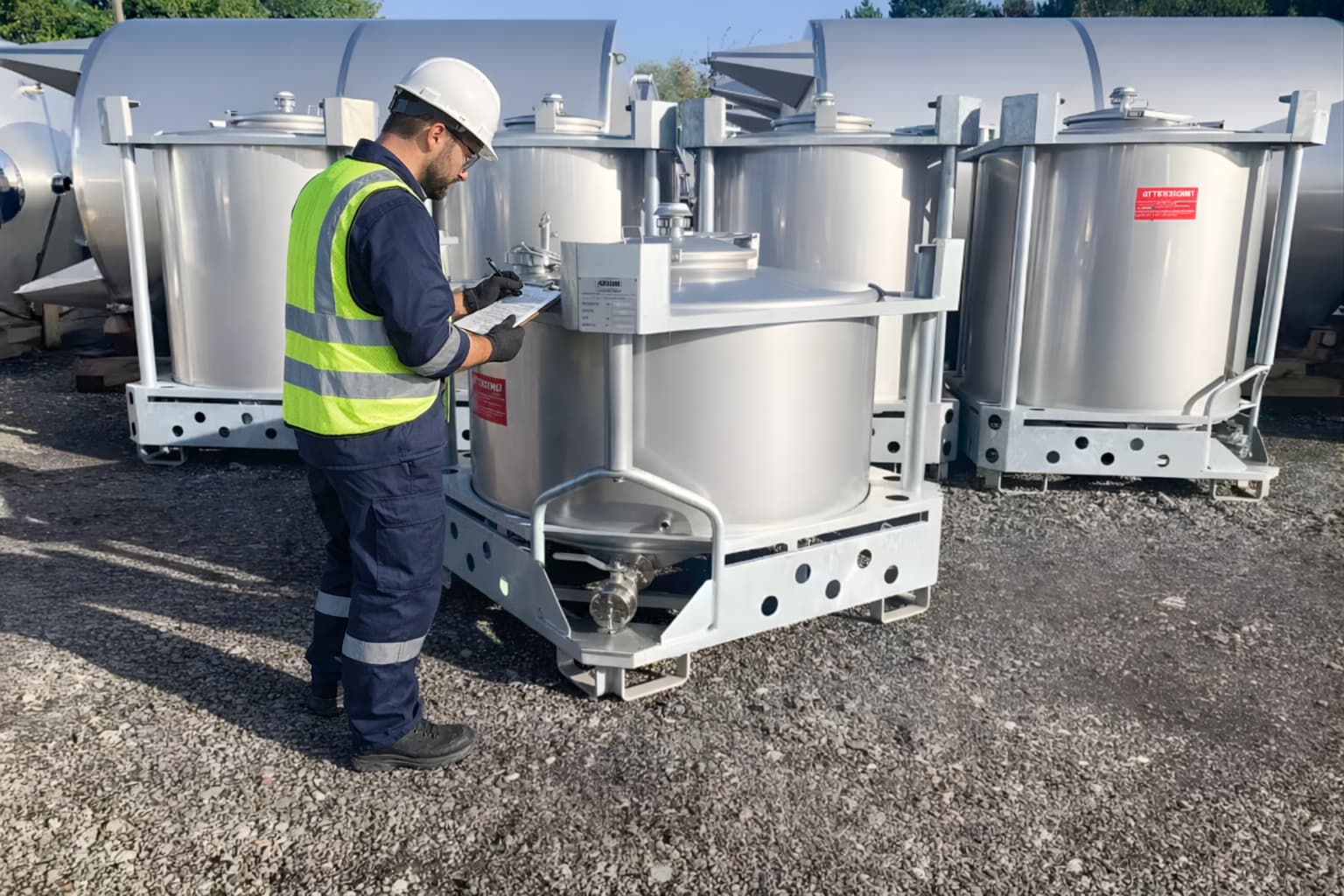
As a long-standing partner of Behälter KG, we recommend that our customers commission the specialist company Contek IBC Service to carry out the inspection and approval of their IBC containers. As an approved inspection body, Contek offers inspections both at their facility and on-site at your premises. In addition, accompanying services such as IBC cleaning or the installation of spare parts can be provided conveniently and reliably from a single source.