 Deutsch
 English
 Italiano
 Español
 Polish
 French
 Dutch
Dutch
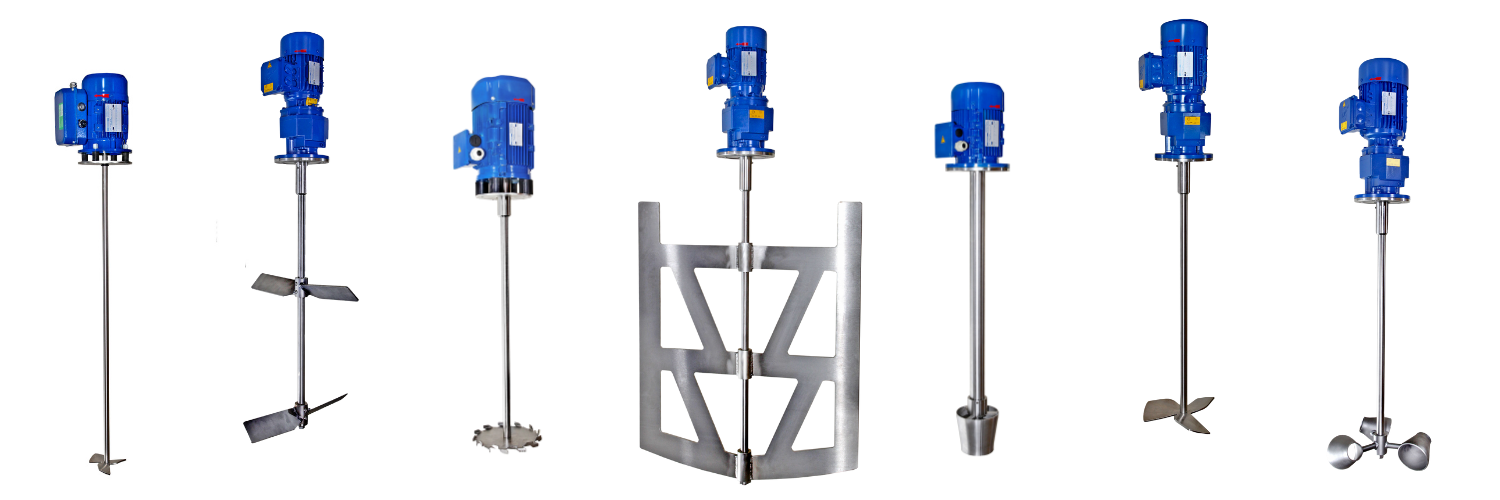
Agitator Finder – Initial Guidance in 30 Seconds
The Agitator Finder provides an initial assessment of which agitator type is typically suitable for your application. The recommendation is based on general empirical values from industrial practice.
Agitator Finder
How to Select the Right Impeller – Key Selection Criteria
The choice of the right agitator depends on three key factors: the viscosity of the medium, the process objective and the structural requirements of the vessel.
Before deciding on an agitator type, it is worth systematically reviewing the following criteria. Each of them influences which impellers are suitable – and which can be ruled out from the start.
- Medium viscosity: Low-viscosity media such as water or solutions are efficiently circulated with high-speed impellers (e.g. propeller). Highly viscous substances such as honey, pastes or adhesives require slow-running, wall-proximate impellers such as the anchor agitator. Important: Many process media exhibit non-Newtonian behaviour – their viscosity changes under shear. A single viscosity value is often insufficient for proper design.
- Process objective: Homogenising, dispersing, suspending, emulsifying or degassing – each objective places different demands on flow characteristics and shear rate.
- Flow direction: Axial impellers generate vertical circulation (suitable for homogenising). Radial impellers generate shear flow (suitable for dispersing). Tangential impellers operate close to the wall (suitable for heat exchange).
- Vessel geometry: Installation position (top head, bottom head, side-mounted), vessel size, height-to-diameter ratio and nozzle diameter determine the selection. An impeller designed for a 1:1 ratio (H/D) operates significantly less efficiently in a slender, tall vessel.
- Hygiene and safety requirements: For sterile processes, seal-free magnetic agitators are an option. Additional requirements apply for use in potentially explosive atmospheres.
The selection criteria presented here provide general guidance. The final selection should always be based on a project-specific process engineering assessment.
In the following sections, we present each agitator type with its specific characteristics.
Agitator Types in Industrial Use – an Overview
Propeller Agitator – for aqueous, low-viscosity media
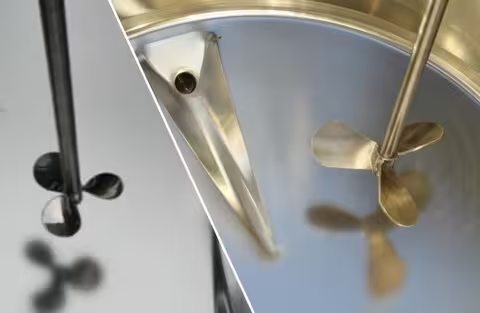
The propeller agitator (also mixing propeller) is one of the most widely used impellers in industrial mixing technology. Its operating principle is based on a strong axial free jet that efficiently circulates the medium from top to bottom.
Typical applications include homogenising, dispersing and suspending liquid media in the low-viscosity range. Due to the long reach of the free jet, the propeller agitator is also suitable for circulating large volumes in storage tanks.
Installation is usually eccentric in the top head. In large storage tanks, the propeller is alternatively mounted on the side of the vessel cylinder. The speed depends on the design: a directly driven high-speed mixer reaches up to 1,500 rpm, while versions with a geared motor offer significantly reduced speeds for gentler applications.
Note: For central installation in low-viscosity media, baffles are generally required to prevent vortex formation. For eccentric installation, baffles can be omitted.
Advantages:
- High circulation capacity with low energy input
- Low maintenance and suitable for continuous operation
- Easy to clean
- Short delivery times
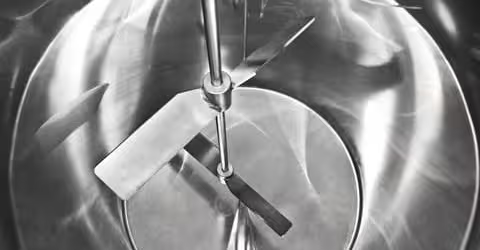
Paddle Agitator – versatile up to medium viscosity
The paddle agitator (also cross-beam or paddle impeller) is a multi-stage mixing system: at least two paddle impellers are mounted on the agitator shaft, generating a high circumferential speed due to their large diameter.
A paddle agitator is therefore always operated with a geared motor that reduces the speed to a two-digit or low three-digit value. Eccentric installation on the vessel top head eliminates the need for additional baffles.
The particular strength of the paddle agitator lies in its broad application range: it reliably mixes aqueous media as well as significantly more viscous substances such as motor oil, syrup or thin paints. The paddle agitator is also well suited for the gentle circulation of large fill volumes.
Advantages:
- Multi-stage mixing system with uniform energy input
- Handles aqueous to medium-viscosity media
- Circulation of large vessel volumes
- Paddles flexibly adjustable on the shaft
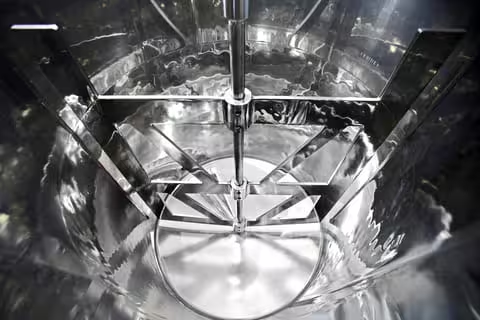
Anchor Agitator – for highly viscous media and heat exchange
When viscous media such as honey, adhesives or thick pastes need to be mixed, the anchor agitator is the impeller of choice. Its anchor-shaped geometry operates close to the vessel wall and thereby ensures intensive renewal of the wall boundary layer.
This offers a decisive advantage: the heat transfer between the medium and the heated or cooled vessel wall is particularly effective with anchor agitators. The primary flow direction is tangential, with eddy zones at the anchor struts.
Between the struts, zones with lower flow velocity form. To minimise this effect, anchor agitators are frequently fitted with additional internals in practice, which ensure more uniform mixing across the entire vessel volume.
Installation is central, without baffles – the highly viscous medium itself acts as a flow brake. PTFE scrapers are optionally available for even more thorough wall wetting.
Advantages:
- Optimised for highly viscous media
- Excellent heat exchange due to wall-proximate mixing
- No baffles required (central installation)
- Optionally with PTFE scrapers
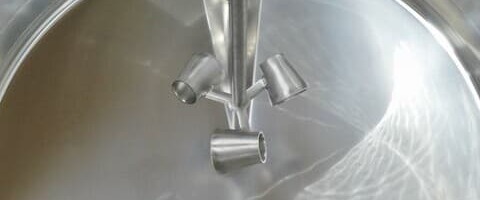
Cup Impeller (Cone Mixer) – gentle mixing at low speed
The cup impeller (also cone mixer, cone impeller or visco mixer) is one of the most versatile impellers. Its cone-shaped design generates sufficient flow even at low speeds for gentle and uniform mixing.
Typical applications include homogenising, blending of additives and degassing. Compared to many other agitator types, the cup impeller excels through shorter mixing times with significantly lower energy consumption.
An additional advantage: process-related side effects are minimal. There is virtually no vortex formation, air entrainment or foaming. The shear transferred to the medium remains low – ideal for shear-sensitive products.
For vessels with a small manway opening (e.g. IBC containers), collapsible cup versions are available. These open automatically by centrifugal force during operation and can be folded for space-saving installation and removal.
Advantages:
- Gentle at low speed – suitable for aqueous to highly viscous media
- Shorter mixing time, lower energy consumption
- Virtually no air entrainment or foaming
- No baffles required
- Optionally as collapsible cup for narrow openings
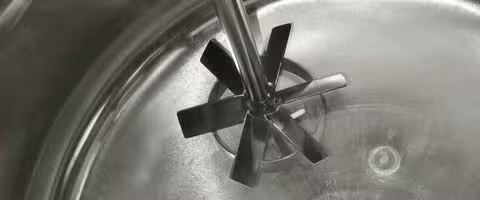
Pitched-blade Impeller – high power input and shear force
The pitched-blade impeller (also cross-blade impeller) consists of 4 to 8 blades, typically arranged at a 45° angle on the shaft. This pitch generates a combined axial and radial flow.
Compared to the propeller agitator, the pitched-blade impeller delivers a higher energy input and more shear force. The result is more turbulent mixing with higher pumping capacity – suitable for applications where more intensive mechanical stress on the medium is desired.
Advantages:
- High power input and shear force
- Combined axial-radial flow
- Can be used in multi-stage configurations
- Easy to clean

Dissolver (Toothed Disc Impeller) – Dispersing and Emulsifying
The dissolver (also toothed disc impeller or disc impeller) is the standard impeller for tasks requiring high shear forces. The toothed disc rotates at high speed, breaking down fine particles or disrupting emulsions.
Primary applications include dispersing, emulsifying, size reduction of solids and wet grinding – particularly in the paint and coatings industry. The high energy input is achieved through the specific geometry of the dissolver disc.
An important limitation: the pumping capacity of the dissolver is comparatively low. For more complex mixing tasks, it is therefore frequently combined with a second impeller – for example with an anchor or cup impeller that simultaneously circulates the entire vessel contents.
Advantages:
- Highest shear forces of all common impellers
- Motor power up to 55 kW possible
- Available as a cost-effective high-speed mixer without gearbox
Jet Mixer – air-free mixing via rotor-stator
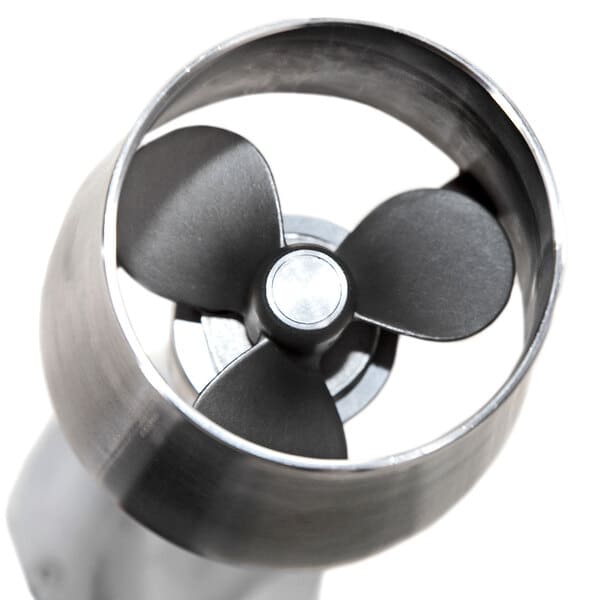
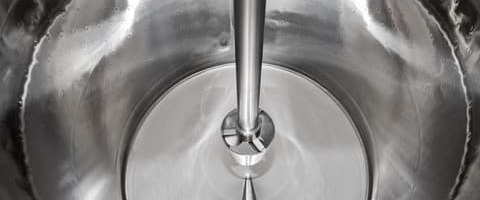
The jet mixer is based on rotor-stator technology and generates a strong, directed axial jet. This mixes the entire vessel contents quickly and – crucially – completely air-free.
Two problems that can occur with other agitator types are eliminated by design: no vortex funnel forms, and sedimentation is reliably prevented. Installation is possible both centrally in the top head and on the side of the vessel cylinder.
Advantages:
- No air entrainment – ideal for air-sensitive media
- No sedimentation
- Reduced mixing time
Magnetic Agitator – for sterile and cleanroom applications
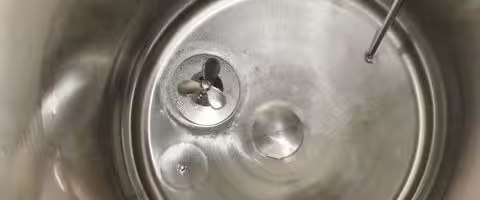
In sterile and hygienic processes – particularly in the pharmaceutical sector – the shaft seal into the vessel represents a critical contamination risk. The magnetic agitator solves this problem: torque transmission occurs contactlessly through a magnetic field, so no shaft seal is required.
The magnetic agitator is installed in the bottom head of the vessel. This ensures mixing even at minimal fill levels – an advantage that top-mounted agitators cannot provide by design.
Magnetic agitators are also excellently suited for use in vacuum or pressure vessels and are available for potentially explosive atmospheres (Ex zone).
Advantages:
- No shaft seal – maximum hygiene
- Operates even at minimal fill levels
- Suitable for vacuum, pressure and Ex zones
- Space-saving design
Mixing Technology by Application – Quick Reference
The following table summarises the key differences between agitator types. It is suitable for quick pre-selection – the final design should always be project-specific.
| Impeller | Viscosity | Flow | Typical application |
|---|---|---|---|
| Propeller agitator | Low (aqueous) | Axial | Homogenising, suspending, circulation in storage tanks |
| Paddle agitator | Low to medium | Axial/radial | Homogenising, circulation of large volumes |
| Anchor agitator | High | Tangential | Heat exchange, homogenising of viscous media |
| Cup impeller | Low to high | Axial | Homogenising, degassing, blending of additives |
| Pitched-blade impeller | Low to medium | Axial/radial | Turbulent mixing, high pumping capacity |
| Dissolver | Low to medium | Radial | Dispersing, emulsifying, wet grinding |
| Jet mixer | Low to medium | Axial (directed) | Air-free mixing, anti-sedimentation |
| Magnetic agitator | Low | Radial | Sterile processes, pharmaceuticals, cleanroom |
The table shows commonly used assignments. Depending on process conditions, a different solution may be required.
In addition to the impellers themselves, we also offer as well as for special applications.
Combining Multiple Impellers for Complex Mixing Processes
When a single impeller cannot meet all process requirements, combining multiple agitators in one vessel is often a better solution than compromising on the individual selection.
A common practical example: a dissolver provides the necessary shear forces for dispersing but has limited pumping capacity. In combination with an anchor agitator or cup impeller, the entire vessel contents are uniformly circulated while the dissolver disc performs its dispersing work locally.
As a general rule: if the process objective can be described with a single parameter (e.g. mixing time or suspension capacity) and the viscosity remains stable during the process, a single impeller is usually sufficient. As soon as the process simultaneously demands conflicting requirements – such as high local shear force and uniform volumetric circulation – no single impeller will achieve an optimal result.
Such multi-agitator systems are individually designed – from the selection of the impellers and the dimensioning of the drives to the installation position in the vessel. If you are unsure which combination is appropriate for your process, technical consultation can assist with the design.
Common Mistakes in Agitator Selection
The most common design errors do not occur in the choice of agitator type, but in the definition of the input parameters – particularly the viscosity.
In practice, we regularly encounter misjudgements that lead to inefficient mixing processes, over-dimensioning or unnecessarily high operating costs. The following points summarise the most common mistakes.
1. Viscosity incorrectly estimated
Viscosity is the most important input parameter for agitator selection – and the one most frequently incorrect. Many process media exhibit non-Newtonian behaviour: their viscosity changes under shear or with temperature changes. A single value at room temperature is insufficient for a reliable design. Ideally, viscosity values are determined at various shear rates and operating temperatures.
2. Vessel geometry ignored
Tank diameter, fill level height, bottom shape and nozzle position directly influence the flow profile. An impeller designed for a vessel with a height-to-diameter ratio of 1:1 operates significantly less efficiently in a slender, tall vessel – dead zones and stratification effects result.
3. Motor power over-dimensioned
A common reflex: "More power cannot hurt." In practice, over-dimensioning leads to higher investment costs, increased mechanical stress on shaft and bearings, and greater demands on the vessel construction. Motor power should be designed so that the operating point is at approximately 85 % of the rated power.
4. Baffles forgotten – or incorrectly applied
In low-viscosity media with central installation, baffles are indispensable: without them, the medium rotates as a rigid body with the impeller – no actual mixing takes place. Power input drops by up to 40 %. Conversely, baffles in highly viscous media are counterproductive: the viscous medium brakes itself, and additional internals only create dead zones.
5. Cleaning requirements not considered
An impeller with dead-space geometry, rough weld seams or hard-to-access shaft-impeller connections cannot be reliably CIP-cleaned. In the food, pharmaceutical and chemical industries, this can lead to non-compliance with hygiene regulations. The cleaning method (CIP, SIP, manual disassembly) should be established before agitator selection.
6. Existing design adopted without review
"That is how we have always done it" is a common justification – but not a design basis. If the medium, process objective or vessel volume have changed, the agitator selection must be re-evaluated. Copying the old specification saves time in the short term but can lead to inefficient processes in the long run.
The recommendations presented here represent typical empirical values and do not replace a process engineering design. In case of uncertainty, we recommend individual consultation.